Modular Smart Button
University Research Project Extract

A functional prototype of a smart button housing a 32-bit SAM
Microcontroller and its power regulating circuit.
Abstract
Electronic textiles (e-textiles), is an emerging field of design engineering aiming to add value to wearable fabrics often in the form of communication, transformation, and evaluation. Often times, this is achieved by adding digital electronic components to soft fabrics in a nonintrusive way.
E-textiles are particularly well-suited to wearable computing applications as textile sensors and circuitry are more comfortable against the body than circuits printed on hard fiberglass or compressed paper substrates. However, while techniques for textile-based sensors and power and signal busses have been developed, currently for all but the most basic system, at some point the textile will need to interface with a hard component such as an integrated circuit on a chip. While there is ongoing work such as the yarns produced by Nottingham Trent University to reduce the size of hard components so that they can be integrated indistinguishably into a textile, soft electronic technologies are still far from achieving high computing power, memory, power storage and so on. This project focuses on applications where it is accepted that hard components will need to be worn, but explores ways to naturally fit them in. It will also focus on applications that require multiple isolated conductive paths between the soft textiles and hard electronics.
A proposed solution is a prototype Integrated Circuit Button (ICB) inspired by clothing buttons that acts as a housing and point of interconnection between a circuit on a rigid PCB and a textile circuit. Below presents the design decisions that have informed iterations of the prototype button and show the button in the context of holding a microcontroller.
Hard components have been a part of fashion since the 13th century, mainly in the form of a button used to attach one half of the fabric to another. To this day they are still found on many shirts, coats, pants, and purses.
Beyond the comfort of the wearer, the life cycle of the worn circuit, including how the circuitry could be made robust against future changes was considered. This could include the need to upgrade firmware or modify a subsection of a circuit. On a more daily basis, the concerns include washability and the ability of the garment to function as a desirable piece of clothing, even when not powered.
A functional prototype of a smart button in the form factor of a men's shirt button housing a 32-bit SAM Microcontroller and its power regulating circuit was produced and tested against normal shirt buttons under extreme conditions.
Background
Interconnections between textiles and PCBs has been a growing area of interest for researchers working with e-textiles. I won’t include an exhaustive list of approaches, but will highlight some key contributions that have influenced my design.
The e-TAGs project [2] explored a variety of connectors to mount a PCB onto a knitted sweater. They found snaps to be cumbersome and large particularly when compared to ribbon cable connectors, however snaps are still a popular means of attaching signal processing electronics to a sensor. They are commonly found on commercial products such as those by OM Signal [4]. This ability to easily detach and securely attach a PCB to a garment is a feature that was designed into the Modular Smart Button.
An additional desired feature was the ability to connect a large number of densely located contacts. Buechley and Eisenberg [1] explored connecting fabric PCBs to microcontrollers by soldering IC sockets holders directly onto the fabric. These Socket Buttons could connect a 40 pin DIP microcontroller to the textile circuit.
Beyond IC socket holders, I was also inspired by Zero Insertion Force sockets, which were also a point of inspiration for [3]. Mehmann et al developed a textile Zero Insertion Force Ball Grid-Array connector as a means to address similar challenges that we are addressing here. They were looking for non-rigid points of contact that would aid in comfort, particularly when the hard connected device was removed and were also interested in being able to remove the hard electronics for washing.
Design
The design requirements for the Modular Smart Button(MSB) are that it must:
-
Enclose a PCB
-
Provide multiple electrical contacts from the PCB to the conductive thread or textile, which can then be connected to other MSB, sensors or actuators
-
Allow the PCB to be removed without damage
-
That the addition of the PCB to the garment must not detract aesthetically or add any points of physical discomfort for the wearer
-
That the garment remains functional as an item of clothing whether the PCB is attached or not
Furthermore, I want to keep my design related to items that are native to clothing and may add to the aesthetic value to the garment, are usually inflexible, and can be big enough to accommodate a circuit, so I chose shirt buttons as the form factor.


Testing Circuit
To test the functionality of the smart button contacts, a PCB housing a 32-bit ATSAMD21E18 Microcontroller and its power regulating circuit was designed in Eagle CAD and printed at Huaqiangbei in Shenzhen.

Testing Integrated Circuit Schematic
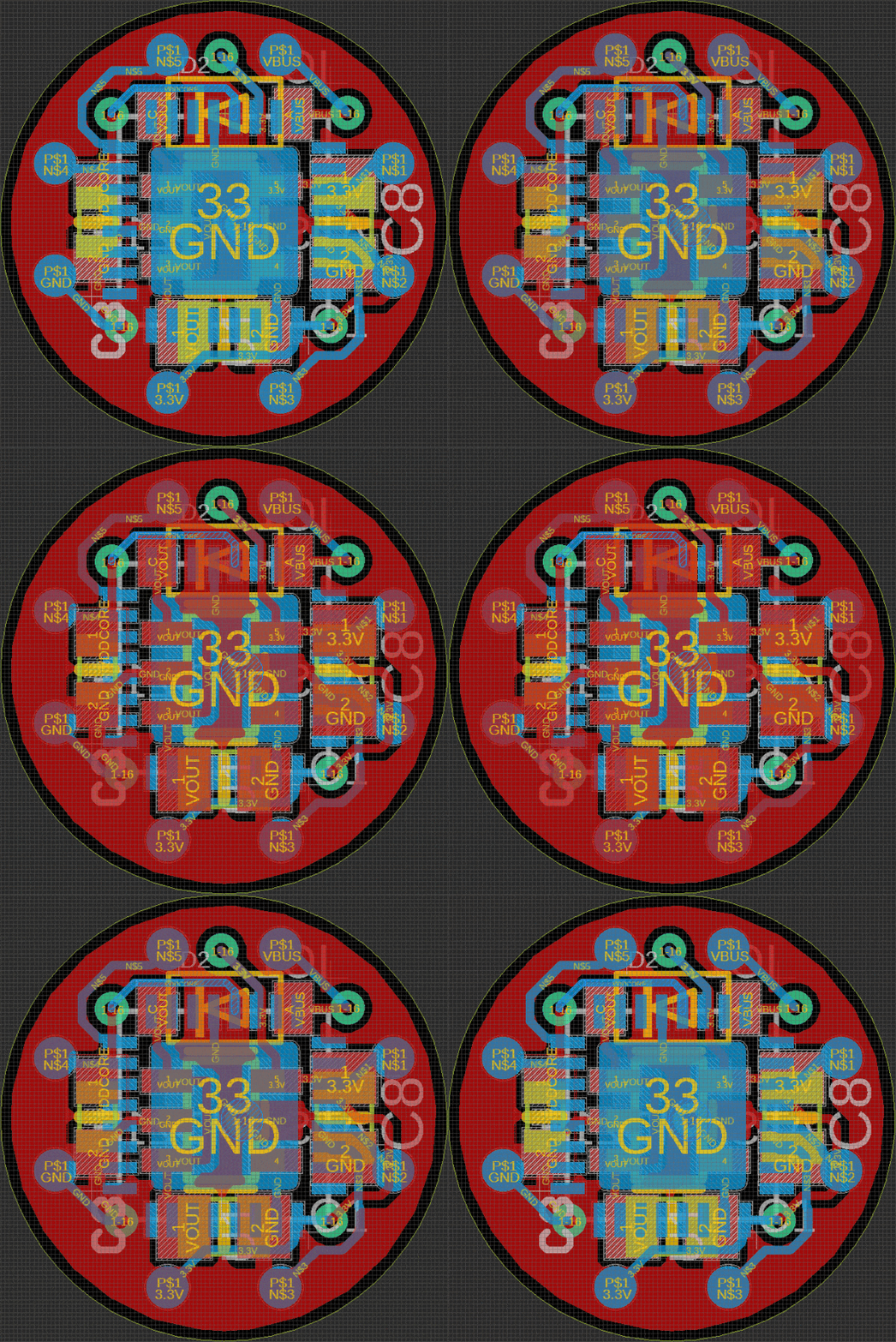
Testing Integrated Circuit Board

Printed Testing IC (left) along with a double RGB LED IC
Testing for Button Functionality
A series of tests were designed to test the functionality of the modular smart button as a shirt button against normal shirt buttons. This was also done for every iteration and was a core driving force in iterative changes.
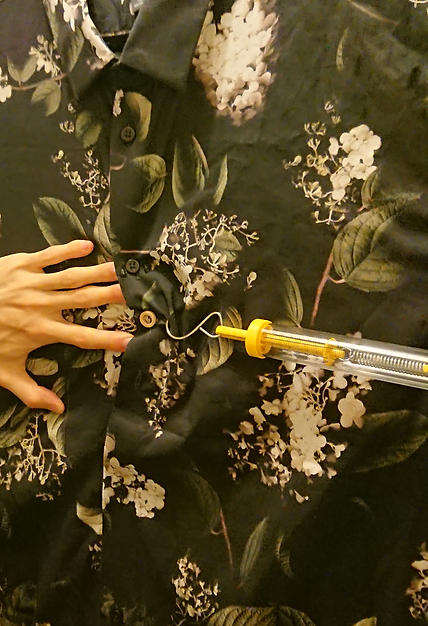
Stretch test - pulling overlapping fabrics along each other on a horizontal plane to simulate stretching due to breathing/body mass. Recorded with a 5kg Newton-meter on one end.
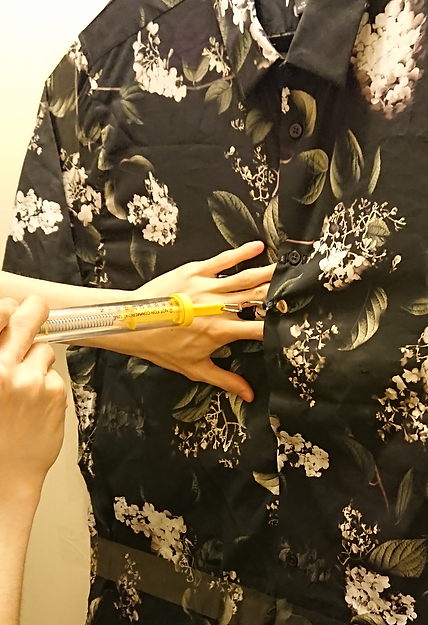
Shear test - pulling overlapping fabrics perpendicular to each other on the horizontal and vertical plane to simulate shear stress or pulling forward, away from the body. This is the easiest way to undo a button. Also recorded with a 5kg Newton-meter on one end.

Table showing results for the stretch test

Table showing results for the shear test

Results for the reassembly test - the average time required to take apart the MSB and PCB and reassembling it
Furthermore, the functional prototype was also thrown entirely into a washing machine and suffered no measurable damage.
References
[1] Buechley, L., and Eisenberg, M. Fabric PCBs, electronic sequins, and socket buttons: techniques for e-textile craft. Personal and Ubiquitous Computing 13, 2 (2009), 133–150.
[2] Lehn, D., Neely, C., and Schoonover, K. e-TAGs: e-textile attached gadgets. In Proceedings of Communication Networks and Distributed Systems: Modeling and Simulation (2004).
[3] Mehmann, A., Varga, M., Gonner, K., and Tr ¨ oster, G. A ball-grid-array-like electronics-to- ¨ textile pocket connector for wearable electronics. In Proceedings of the 2015 ACM International Symposium on Wearable Computers - ISWC ’15, ACM Press (New York, New York, USA, 2015), 57–60.
[4] OMsignal Inc. OM Signals. http://www.omsignal.com/ accessed 9 April, 2016.
[5] Rathnayake, A., and Dias, T. Yarns with embedded electronics. In Proceedings of the 2015 ACM International Joint Conference on Pervasive and Ubiquitous Computing and Proceedings of the 2015 ACM International Symposium on Wearable Computers - UbiComp ’15, ACM Press (New York, New York, USA, 2015), 385–388.
Still Curious?
Additional information on this project might be private, but please feel free to contact me to learn more!